Showing posts with label Clothing Definitions. Show all posts

Vintage Fashion Design of Coats from the 1940s

Tuesday, October 16, 2012

I have just come across a wealth of pictorial information via the New York Public Library Digital Gallery and I am so very thankful that this website exists to better educate and inform us of vintage fashions of the 1940s (and other decades!) through fashion design illustrations.

Imagine my excitement as I "leafed" through page after page of fashion designs illustrating coats from the 1940s with small notations. Some of these fashion terms I have not come across yet and I have tried to my best ability to include these terms and definition with the images below.

Vintage 1940s Fashion Design Coat from the New York Public Library Digital Gallery
Plaid coat with four bias patch pockets covered with flaps. Spring 1940-1941

Vintage 1940s Fashion Design Coat from the New York Public Library Digital Gallery
Wide cape sleeve on plaid coat. Spring 1940-1941

Vintage 1940s Fashion Design Coat from the New York Public Library Digital Gallery
Frog closure on front of coat. Front flare. Spring 1940-1941.

Vintage 1940s Fashion Design Coat from the New York Public Library Digital Gallery
Faille silk imported (not sure if that is the actual word, hard to read) in sleeves and edging closing. Spring 1940-1941.

What is FAILLE SILK?
I have seen the word "faille" before but never actually knew what it meant. So according to New York Fashion Center: "A slightly glossy silk with strongly defined soft, wide ribs, silk faille is heavy in weight but maintains a shallow, graceful drape. An exceptionally soft hand and readiness to take a crease makes this fabric beautiful for use in tailored suits and jackets. Silk faille retains a light sheen that draws attention to its premium silk fibers, without being too glossy for the workplace or formal settings."

Vintage 1940s Fashion Design Coat from the New York Public Library Digital Gallery
"Dandy" Reefer. Double breasted with deep cuffs. Spring 1940-1941.

What is a REEFER coat?
I have never come across this term up until seeing these fashion illustrations. I always just referred to coats like these as trench coats. But according to Army Navy Deals: "The reefer jacket was of naval origin, and described the short double breasted jacket worn by sailors in harsh weather, when they perform duties such as reefing the sails."

and according to The Free Dictionary: "1. A short, heavy, close-fitting, double-breasted jacket.
2. A close-fitting, single-breasted or double-breasted coat.
"

Vintage 1940s Fashion Design Coat from the New York Public Library Digital Gallery
Cape sleeve on lounge coat. Spring 1940-1941.

Vintage 1940s Fashion Design Coat from the New York Public Library Digital Gallery
"Dandy" reefer coat with detachable tiered cape. Spring 1940-1941.

Vintage 1940s Fashion Design Coat from the New York Public Library Digital Gallery
Fitted coat, soft bodice (?), set in flare gives front fullness ending in pockets. Fashion drawing 1938.

Vintage 1940s Fashion Design Coat from the New York Public Library Digital Gallery
Yoke continuing to drop shoulder and skirt of matching faille silk or contrasting wool. Spring 1940-1941.

Vintage 1940s Fashion Design Coat from the New York Public Library Digital Gallery
Fox collared boxy tweet coat. Soft nose on body beneath collar. Spring 1940-1941.

What is Vintage Millinery + an Introduction to the Queen of Millinery, Sally Victor

Sunday, November 6, 2011

In the world of vintage I think it is always important to learn as much as possible about it. And today I wanted to spend some time talking about what exactly vintage millinery is as in the past I always confused it with hat making. What brought about these ponderings was a meet-n-greet with this lovely 1940s cage hat adorned with cherries and berries and little Autumn flowers and I thought how lovely would that be for the holidays... but unfortunately the vintage hat was not for sale. Oh the sadness! So then I proceeded to thinking perhaps I can just recreate something similar and did a little bit of research for millinery supplies, but I have yet to come across those adorable little cherries and berries.

The Milliner and Dressmaker, 1875.  NYPL Digital Collections
{ image source }

Anyhow, without further ado...

What is Millinery? In the most simplest of definitions, millinery refers to hat dressing or designing hats. Sometimes it can mean the manufacturing of hats, but for the most part millinery refers to designing hats.

One of the most famous American milliners is Sally Victor whose vintage hats are showcased at the The Metropolitan Museum of Art. These two vintage Sally Victor hats from the 1930s are my favorites! J'adore!!!

Vintage Millinery Hat by Sally Victor 1930s


Sally Victor was born in Scranton, PA on Feb 23, 1905. She studied art in Paris for a couple of years and sewed and designed her own clothes from the age of 14. What started her millinery career was being a hat buyer for Macy's in New York City. When she got a job at L. Bamberger & Co., she met her future husband, Sergiu Victor, a hat manufacturer. Eventually she became so successful as hat designer that Sergiu closed down his hat manufacturing company to join her in her millinery adventures. And what a wonderfully beautiful journey it was!

Sally Victor Vintage Hat Designer Inspecting a Straw Hat
A photo of milliner, Sally Victor, inspecting a straw hat surrounded by vintage millinery supplies.

Vintage Advertisement for Whitman's Chocolate Featuring Sally Victor Hat
A vintage advertisement for Whitman's Chocolate featuring a rose adorned vintage hat by Sally Victor.


There is a fantastic little read and preview photos of the hat exhibition at the Brooklyn Museum Sally Victor: Mad Hatter. I'm hoping to dwelve a little bit into hat designing, small steps, baby steps. I can't even find the proper millinery supplies!

Vintage Glossary: B is for Bolero

Friday, February 25, 2011

Boleros were mostly popular in the late 30s and into the 40s and there was a sprinkling of it into the early 1950s. They were almost always an accompaniment to a dress or suit but we've seen boleros with summer playsuits and pant suits.


Definition of Bolero: A short cropped jacket ending above or at the waist and worn open. Most boleros do not have a collar or lapels.


Vintage boleros from the 1930s to the early 1950s.

So what exactly is a bolero? Usually when one thinks of a bolero visions of a Spanish matador come into mind, which is correct as the bolero jacket was derived from this fashion. (At least to the best of our knowledge!) To keep it simple, just remember that a bolero never has closures. If it does then it's a cropped jacket, not a bolero.

Defining Vintage: Natural + Artificial Fibres

Thursday, January 21, 2010

What is the difference between natural fibres and artificial fibres? Well, in this post I will attempt to explain and educate. :)


A vintage sweater most likely made from fabric containing acrylic. A vintage dress pattern that looks best with natural fabrics like cotton or linen.

Natural fibre are fibers derived from plants and animals. Natural = nature. A few examples would be cotton, wool, and linen. Usually natural fibers tend to wrinkle and crease more easily than artificial fibers. Natural fibers also breathe more easily and respond to change in temperature and different climates. So, if it's a hot sunny day you are better off wearing a cotton shirt than a polyester one. And if you wash a wool sweater in hot water... it shrinks!

Artificial or Synthetic fibres begin as chemical solutions. They can also be made from natural fibres but are processed to create a synthetic fiber. Synthetic fibers are not as porous as natural fibers and are also not as absorbent (don't wear polyester if you're going to be sweating...) On the plus side, synthetic fibers tend to wrinkle less and have less creases.

Here are some examples of fabrics made from artificial fibres:
1.} Acrylic - sweaters, dresses
2.} Nylon - dresses, lingerie, blouses
3.} Polyester - dresses, suits, blouses, linings, lingerie
4.} Rayon - dresses, blouses, draperies, linings
5.} Acetate - lingerie, dresses, blouses

I have seen all these on a clothing label at one point or another. However, sometimes a fabric content label won't be present so I do my best to guess. I am not a fabric expert by any means, but by doing plenty of research I think I will be able to better define the fabric contents of the many vintage clothes I have in the { SHOP }

*I am still learning and researching, so if you see an error, please feel free to correct me*

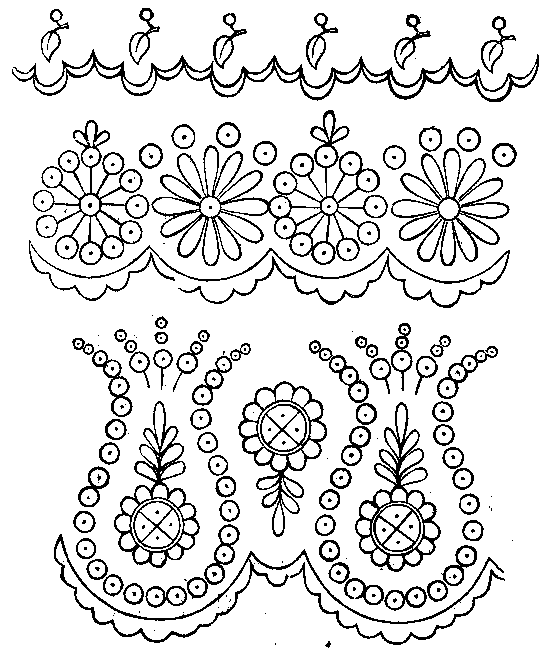
What is Broderie Anglaise?

Thursday, October 1, 2009

Broderie Anglaise ("English Embroidery") is a type of whitework needlework that usually features eyelets and buttonhole stitches. (Whitework means white thread on white, blackwork means black stitching on white).

I always confused eyelet with broderie anglaise (it is a common mistake as broderie anglaise HAS eyelet holes in it) but broderie anglaise is more elaborate and much more time consuming and often features floral patterns.

It became popular in the 19th century in England and may have come or been inspired from the delicate and ornate Ayrshire needlework (Scotland). Broderie anglaise was mostly used on linens, undergarments, and christening gowns.


Sources: 1.] 1922 French fashion plate Pratt Libraries, 2.] Blouse from cherchons.com, 3.] Dahlia Dress from ASOS, 4.] Broderie anglaise cape top 1860-1960.com, 5.] Detail of hem Corsets and Crinolines, 6.] Patterns for broderie anglaise Marquise.de

Peter Pan Collars

Sunday, September 27, 2009

What is a Peter Pan Collar?
A Peter Pan collar is a specific type of shirt collar, usually found on women's and girl's clothing. The shape and name of the Peter Pan collar appear to have originated in the mid-twentieth century. The design became very popular for school uniforms, and began to spill over into popular culture. Despite being named after a masculine character, the Peter Pan collar is associated primarily with feminine wear, and rarely appears in men's fashion.
Credit: Wise Geek


Sources: Collectoratorone, Devon Smith, Annabelle Rose, Carl's Old Photos,

What is a Peplum?

Wednesday, July 15, 2009

In reference to clothing, a peplum is a short overskirt that is usually attached to a dress, blouse, or jacket.

Be My Chap Dress Vintage 1940s Dubarry Lace Peplum Dress available soon in our vintage shop!


Plum Perfect Dress at Anthropologie


Now you know! :)